Can a Goliath Use a Lance in One Hand

A lance is a pole weapon designed to exist used by a mounted warrior or cavalry soldier (lancer). During the periods of classical and medieval warfare, it evolved into existence the leading weapon in cavalry charges, and was unsuited for throwing or for repeated thrusting, unlike similar weapons of the javelin and pike family typically used past infantry. Lances were often equipped with a vamplate – a pocket-size circular plate to prevent the hand sliding up the shaft upon impact. Though best known as a military and sporting weapon carried by European knights, the utilise of lances was widespread throughout Asia, the Middle Due east, and North Africa wherever suitable mounts were available. Equally a secondary weapon, lancers of the medieval catamenia also carried daggers, swords, axes, hammers, or maces for use in hand-to-mitt gainsay, since the lance was often a one-use-per-engagement weapon; assuming the lance survived the initial impact intact, it was (depending on the lance) normally too long, heavy, and slow to be effective against opponents in a melee.[1]
Etymology [edit]
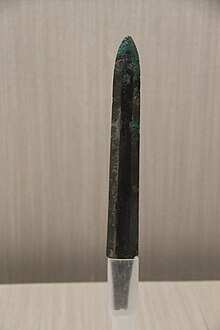
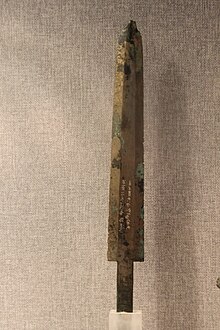
The name is derived from the word lancea - the Roman auxiliaries' javelin or throwing spear; although according to the OED, the word may be of Iberian origin. Also compare λόγχη ( lónkhē ), a Greek term for "spear" or "lance".
A lance in the original sense is a low-cal throwing spear or javelin. The English verb to launch "fling, hurl, throw" is derived from the term (via Old French lancier ), as well every bit the rarer or poetic to lance. The term from the 17th century came to refer specifically to spears non thrown, used for thrusting past heavy cavalry, and especially in jousting. The longer types of thrusting spear used by infantry are ordinarily referred to as pikes.
History of employ [edit]
Middle Ages [edit]
The Byzantine cavalry used lances (Kontos (weapon) or kontarion) virtually exclusively, frequently in assorted mounted archer and lancer formations (cursores et defensores). The Byzantines used lances in both overarm and underarm grips, as well every bit being couched under the arm (held horizontally). The length of the standard kontarion is estimated at virtually 2.5 meters (8.2 ft), which is shorter than that of the medieval knight of Western Europe.[2]
Formations of knights were known to apply underarm-couched military lances in full-gallop closed-ranks charges against lines of opposing infantry or cavalry. Two variants on the couched lance charge developed, the French method, en haie, with lancers in a double line and the German method, with lancers drawn up in a deeper germination which was often wedge-shaped. It is usually believed that this became the ascendant European cavalry tactic in the 11th century after the development of the cantled saddle and stirrups (the Neat Stirrup Controversy), and of rowel spurs (which enabled better control of the mount). Cavalry thus outfitted and deployed had a tremendous collective strength in their charge, and could shatter most contemporary infantry lines.
Considering of the extreme stopping power of a thrusting spear, it apace became a popular weapon of infantry in the Late Center Ages. These eventually led to the ascent of the longest type of spears, the pike. This adaptation of the cavalry lance to infantry use was largely tasked with stopping lance-armed cavalry charges. During the 14th, 15th, and 16th centuries, these weapons, both mounted and unmounted, were so effective that lancers and pikemen non merely became a staple of every Western ground forces, but also became highly sought-afterwards mercenaries. (However, the pike had already been used by Philip Ii of Macedon in antiquity to groovy result, in the form of the sarissa.)
In Europe, a jousting lance was a variation of the knight's lance which was modified from its original war design. In jousting, the lance tips would normally be blunt, often spread out like a cup or furniture foot, to provide a wider impact surface designed to unseat the opposing rider without spearing him through. The centre of the shaft of such lances could exist designed to be hollow, in order for it to pause on touch on, every bit a further safeguard against impalement. They were on average 3 meters (nine.eight ft) long, and had hand guards congenital into the lance, often tapering for a considerable portion of the weapon's length. These are the versions that can most often be seen at medieval reenactment festivals. In state of war, lances were much more than like stout spears, long and balanced for one-handed utilise, and with sharpened tips.
Lance (unit arrangement) [edit]
Every bit a minor unit that surrounded a knight when he went into battle during the 14th and 15th centuries, a lance might have consisted of one or two squires, the knight himself, i to 3 men-at-artillery, and possibly an archer. Lances were often combined nether the banner of a higher-ranking nobleman to form companies of knights that would deed every bit an ad hoc unit.
17th and 18th century decline in Western Europe [edit]
The appearance of wheellock technology spelled the terminate of the lance in Western Europe, with newer types of heavy cavalry such as reiters and cuirassiers spurning the old 1-utilise weapon and increasingly supplanting the older gendarme blazon Medieval cavalry. While many Renaissance captains such as Sir Roger Williams continued to espouse the virtues of the lance, many such every bit François de la Noue openly encouraged its abandonment in the face of the pistol's greater armor piercing power, handiness and greater general utility. At the same time the adoption of pike and shot tactic by most infantry forces would neuter much of the ability of the lancer'south breakneck charge, making them a non-cost effective type of military unit of measurement due to their expensive horses in comparison to cuirassiers and reiters, who usually charging only at a trot could make practice with lower quality mounts. After the success of pistol-armed Huguenot heavy horse against their Royalist counterparts during the French Wars of Organized religion, most Western European powers started rearming their lancers with pistols, initially as an adjunct weapon and eventually as a replacement, with the Spanish retaining the lance the longest.[three]
Only the Polish–Lithuanian Commonwealth with its far greater emphasis on cavalry warfare, large population of Szlachta nobility and general lower war machine technology level among its foes retained the lance to a considerable degree, with the famously winged Polish hussars having their glory flow during the 17th and 18th centuries confronting a wide variety of enemy forces.[3]
Indigenous use in North America [edit]
After the Western introduction of the horse to the Native Americans, the Plains Indians also took up the lance, probably independently, as American cavalry of the time were pistol and sabre armed, firing frontwards at full gallop.
19th century revival in Western Europe [edit]
The mounted lancer experienced a renaissance in the 19th century. This followed on the demise of the pike and of body armor during the early on 18th century, with the reintroduction of lances coming from Poland and Hungary. In both countries formations of lance-armed cavalry had been retained when they disappeared elsewhere in Europe. Lancers became especially prevalent during and after the Napoleonic Wars: a period when almost all the major European powers reintroduced the lance into their respective cavalry arsenals. Formations of uhlans and other types of cavalry used lances betwixt two and 3 meters (6.vi and 9.8 ft) in length as their primary weapons. The lance was usually employed in initial charges in shut formation, with sabers beingness used in the melee that followed.
The Crimean State of war saw the use of the lance in the Accuse of the Light Brigade. One of the four British regiments involved in the charge, plus the Russian Cossacks who counter-attacked, were armed with this weapon.
During the State of war of the Triple Alliance (1864–70), the Paraguayan cavalry made effective use of locally manufactured lances, both of conventional design and of an antique pattern used by gauchos for cattle herding.[four]
The 1860s and 1870s saw the increasing common usage of ash, bamboo, beech, or pine wood for lance shafts of varying lengths, each with steel points and butts, adopted by the uhlan regiments of the Saxon, Württemberg, Bavarian, and Prussian armies.
Twilight of use [edit]
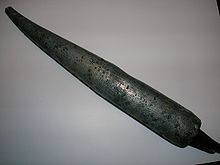
The Franco-Prussian War of 1870 saw the extensive deployment of cavalry armed with lances on both sides. While the opportunities for using this weapon effectively proved infrequent during the actual conflict, the entire cavalry corps (hussars, dragoons, cuirassiers, and uhlans) of the post-war Purple German Army afterwards adopted the lance as a principal weapon. After 1893 the standard German cavalry lance was made of drawn tubular steel, covered with clear lacquer and with a hemp hand-grip.[5] At 3.58 meters (xi.7 ft) it was the longest version and then in employ.[6]
The Austrian cavalry had included regiments armed with lances since 1784. In 1884 the lance ceased to be carried either as an active service or parade weapon. Notwithstanding the 11 Uhlan regiments continued in beingness until 1918, armed with the standard cavalry sabre.[7]
During the Second Boer War, British troops successfully used the lance on one occasion - confronting retreating Boers at the Boxing of Elandslaagte (21 October 1899).[viii] Nonetheless, the Boers fabricated effective use of trench warfare, rapid-fire field artillery, continuous-fire motorcar guns, and accurate long-range repeating rifles from the starting time of the war. The combined effect was devastating, so much of the British cavalry was deployed as mounted infantry, dismounting to fight on foot. For some years after the Boer War, the six British lancer regiments officially carried the lance merely for parades and other formalism duties. At the regimental level, training in the use of the lance continued, ostensibly to improve recruit riding skills. In 1909,[9] the 2.7-meter (viii.nine ft) bamboo or ash lance with a steel head was reauthorized for general utilize on active service.[vi]
The Russian cavalry (except for the Cossacks) discarded the lance in the late 19th century, but in 1907, it was reissued for use by the front line of each squadron when charging in open up germination. In its last form, the Russian lance was a long metallic tube with a steel head and leather arm strap. Information technology was intended equally a shock weapon in the charge, to be dropped later bear upon and replaced past the sword for close combat in a melee. While demoralizing to an opponent, the lance was recognized as being an awkward encumbrance in forested regions.[x]
The relative value of the lance and the sword every bit a principal weapon for mounted troops was an effect of dispute in the years immediately preceding World War I. Opponents of the lance argued that the weapon was clumsy, conspicuous, easily deflected, and inefficient in a melee. Arguments favoring the retentivity of the lance focused on the impact on morale of having charging cavalry preceded by "a hedge of steel" and on the effectiveness of the weapon against fleeing opponents.[6]
World State of war I and after [edit]

Drawing from The War Illustrated representing a Russian Don Cossack lancing a High german infantryman.
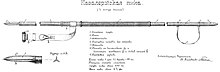
Russian lance "cavalry expressway", type of 1910.
Lances were all the same in utilize by the British, Turkish, Italian, Spanish, French, Belgian, Indian, German, and Russian armies at the outbreak of World War I. In initial cavalry skirmishes in France this antiquarian weapon proved ineffective, High german uhlans being "hampered by their long lances and a good many threw them away".[11] A major action involving repeated charges past 4 regiments of German cavalry, all armed with lances, at Halen on 12 August 1914 was unsuccessful.[12] Amongst the Belgian defenders was ane regiment of lancers who fought dismounted.
With the appearance of trench warfare, lances and the cavalry that carried them ceased to play a significant role.[13] A Russian cavalry officer whose regiment carried lances throughout the state of war recorded only one example where an opponent was killed by this weapon.
The Greco-Turkish War of 1919-22 saw an unexpected revival of lances amongst the cavalry of the Turkish National Army. During the successful Turkish offensives of the final stages of the war across the open up plains of Asia Minor, Turkish mounted troops were armed with bamboo shafted-lances taken from military storage and inflicted heavy losses on the retreating Greek Army.[fourteen]
Those armies which still retained lances equally a service weapon at the end of Earth War I by and large discarded them for all but ceremonial occasions during the 1920s and 1930s. An exception was the Polish cavalry, which retained the lance for gainsay use until either 1934[15] or 1937,[16] but reverse to popular legend did not make use of it in World State of war 2. High german cavalry retained the lance (the Stahlrohrlanze) as a service weapon until 1927,[17] as did British cavalry until 1928.[18] The Argentine cavalry was photographed conveying lances until the 1940s, only this appears to have been used as office of recruit riding school training, rather than serious preparation for active service.
Use every bit flagstaff [edit]
The United States Cavalry used a lance-like shaft as a flagstaff.
Mounted police force use [edit]
When the Canadian North-West Mounted Police was established, it was modeled subsequently certain British cavalry units that used lances. Information technology made express use of this weapon in small detachments during the 1870s, intended to impress indigenous peoples.[19]
The modern Majestic Canadian Mounted Police, the Northward-West Mounted Police's descendant, employs ceremonial, though functional, lances made of male bamboo. They feature a crimped swallowtail pennant, red to a higher place and white below, symbolic of the long evidently material that was wrapped only below the precipitous metal tip for arresting blood fluid to go on it from running down the shaft and making the lance slippery to hold on to and control.
The New South Wales Mounted Police, based at Redfern Barracks, Sydney, Commonwealth of australia, carry a lance with a navy blueish and white pennant on ceremonial occasions.
Other weapons [edit]
"Lance" is also the name given by some anthropologists to the calorie-free flexible javelins (technically darts) thrown by atlatls (spear-throwing sticks), but these are commonly called "atlatl javelins". Some were not much larger than arrows, and were typically feather-fletched like an arrow and unlike the vast majority of spears and javelins (one exception would be several instances of the many types of ballista bolt, a mechanically-thrown spear).
A "tilting-spear" is a heraldric term for a lance.[20]
Run into also [edit]
- Tent pegging
References [edit]
- ^ Ian Heath, page 33 "Armies of Feudal Europe 1066-1300", Wargames Inquiry Group 1978"
- ^ Dawson, Timothy (xviii August 2009). Byzantine Cavalryman c.900-1204. p. 36. ISBN978-1-84603-404-6.
- ^ a b Frye, Gordon. "From Lance to Pistol: The Evolution of Mounted Soldiers from 1550 to 1600". myArmoury.com . Retrieved 21 July 2014.
- ^ Esposito, Gabriele (24 March 2015). Armies of the War of the Triple Alliance 1864-70. pp. 33 & 44. ISBN978-1-4728-0725-0.
- ^ Herr, Ulrich (2006). The German Cavalry from 1871 to 1914. pp. 126–128. ISBN3-902526-07-vi.
- ^ a b c Encyclopædia Britannica, Eleventh Improver, Volume Xvi, p. 150
- ^ Lucas, James (1987). Fighting Troops of the Austro-Hungarian Regular army 1868-1914. p. 112. ISBN0-946771-04-9.
- ^ Thomas Pakenham, pages 139-140, "The Boer War", ISBN 0-7474-0976-5
- ^ Anglesey, Marquess of. A History of British Cavalry Vol. 4. p. 410. ISBN978-0-436-27321-6.
- ^ Vladimir Littauer, pp. 115-116, Russian Hussar, ISBN i-59048-256-5
- ^ Barbara West. Tuchman, folio 280, The Guns of August, Four Square Edition 1964
- ^ Joe Robinson, Francis Hendriks and Janet Robinson, The Final Great Cavalry Charge - The BattIndian]]le of the Silver Helmets Halen 12 August 1914, ISBN 978-1-78155-183-7
- ^ A British officeholder writing in 1917 referred to lancers every bit "our marvellous medieval regiments"
- ^ Philip S. Jowett, Armies of the Greek-Turkish War 1919-22, p. 47, ISBN 978-one-4728-0684-0
- ^ Steven J. Zaloga, page 5 "The Polish Army 1939-45" ISBN 0-85045-417-4
- ^ Alan Larsen & Henry Yallop, The Cavalry Lance, p. 76, ISBN 978-i-4728-1618-four
- ^ Klaus Richter, Weapons & Equipment of the German language Cavalry: 1935-1945, p. 3, ISBN 978-0-88740-816-eight
- ^ Alan Larsen & Henry Yallop, The Cavalry Lance, p. 16 and p.56, ISBN 978-1-4728-1618-4
- ^ Ross, David (1988). The Purple Canadian Mounted Police 1873-1987 . p. 24. ISBN0-85045-834-X.
- ^ Scott-Giles, C. Wilfrid (Charles Wilfrid) (1950). Shakespeare's heraldry. London, Paring. p. 41.
Further reading [edit]
- Delbrück, Hans. History of the Fine art of State of war, originally published in 1920; University of Nebraska Press (reprint), 1990 (trans. J. Renfroe Walter). Volume III: Medieval Warfare.
External links [edit]
 | Wikimedia Commons has media related to Lances. |
 | Await up lance in Wiktionary, the gratuitous dictionary. |
- From Lance to Pistol: The Evolution of Mounted Soldiers from 1550 to 1600 (myArmoury.com article)
keetonutmacksmay39.blogspot.com
Source: https://en.wikipedia.org/wiki/Lance
0 Response to "Can a Goliath Use a Lance in One Hand"
Post a Comment